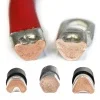
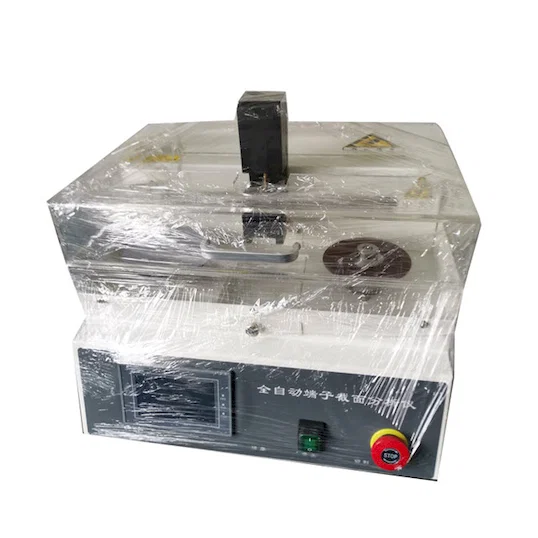
The WPM-SES prepares and images crimp cross-sections from 0.13 to 6.00 mm². The sample is cut by a 105 mm outside diameter, 0.5 mm thick blade on a 2800 rpm spindle at 2 mm/s feed, ground on a 100 mm sandpaper disc at the same 2800 rpm, etched electrolytically for 5 to 30 s, and then viewed through a 10x eyepiece optical instrument at 0.75x to 5.0x with the image captured to a PC. The preparation sequence runs from a Mitsubishi SBL PLC.
A crimp section is only readable if the cut passes through the middle of the barrel and the strands are not smeared: a saw, or a blade used past its life, pulls copper across the voids and the section then looks better than the crimp is. The Z axis removes 0.00 to 5.00 mm per setting so the sample can be stepped down to the barrel centreline, the X axis is driven by a Panasonic servo for repeatable passes, and the 5 to 30 s electrolytic step contrasts the grain boundaries between the strands and the terminal barrel, so compaction is judged from the image rather than estimated. The observation range is 1.2 to 8.2 mm, which covers a single 0.13 mm² strand up to a 6 mm² barrel in one instrument.
The SE4 is the integrated alternative: 0.01-50 mm², 30-312X video magnification, a 5-megapixel Japanese camera and a 500 x 350 x 350 mm housing. The SES stays with a 10x eyepiece at 0.75-5.0x, covers 0.13-6.00 mm² and adds a 5-30 s electrolytic etch that the SE4 specification does not list. Where the work is 0.5-6 mm² terminals and the judgement turns on strand compaction, the etch is the reason to choose the SES; where the range runs from 0.01 mm² wire to 50 mm² lugs, the SE4 covers it in one fixture.
Key Features
1. Section range 0.13-6.00 mm², with electrolytic etching rated up to 6 mm².
2. Cutting spindle at 2800 rpm from a German imported motor, feed rate 2 mm/s.
3. Cutting wheel 105 mm outside diameter, 0.5 mm thick, 21.7 mm bore, German imported.
4. Z axis adjustable from 0.00 to 5.00 mm for stepwise removal down to the barrel centreline.
5. Grinding at 2800 rpm on a 100 mm sandpaper disc; X axis on a Japanese Panasonic servo motor.
6. Electrolysis time 5 to 30 s, followed by a 10x eyepiece optical instrument with 0.75x to 5.0x magnification and a 1.2-8.2 mm observation range.
Technical Specifications
| Parameter | Specification |
|---|
| Model Number | WPM-SES |
|---|
| Machine type | Portable crimp cross-section analyzer (cut, grind, etch, image) |
|---|
| Control System | Japanese Mitsubishi PLC controller - SBL |
|---|
| Module Cut Range | 0.13 ~ 6.00 mm² |
|---|
| Rotate Speed | 2800 rpm (German imported motor) |
|---|
| Cut Speed | 2 mm/sec |
|---|
| Cut Wheel | 21.7 mm inner diameter, 105 mm OD, 0.5 mm thickness (Germany imported) |
|---|
| Module Grind Speed | 2800 rpm (German imported motor) |
|---|
| Z-axis Tuning Range | 0.00 ~ 5.00 mm |
|---|
| Special Sandpaper OD | 100 mm |
|---|
| X-axis Shift | Japanese Panasonic servo motor |
|---|
| Eclipse Partial Electrolysis | Up to 6 mm² |
|---|
| Electrolysis Time | 5 ~ 30 sec |
|---|
| Picture Ingestion | High quality, low distortion optical instrument with 10x eyepiece |
|---|
| Amplify Multiple | 0.75x, 1x, 1.5x, 2.0x, 2.5x, 3.0x, 3.5x, 4.0x, 4.5x, 5.0x |
|---|
| Observation Range | 1.2 ~ 8.2 mm |
|---|
Applications
— Harness plants, incoming inspection: sections of ring and tab terminals from a new reel checked for strand compaction and barrel fill before the reel is released.
— Automotive crimp validation: sectioning of 0.35-2.5 mm² terminal joints from production at the barrel centreline, for crimp height and void measurement.
— Appliance cordset manufacture: sections of plug blade and earth terminal crimps on 0.75-1.5 mm² cord.
— Terminal supplier PPAP: sample sections prepared, etched and photographed for the dimensional report.
— Failure analysis: sections cut from returned assemblies where a joint opened in service, to establish whether the crimp or the wire failed.
 English
 Chinese
 Russian
 French
 Spanish
 Arabic
 German
 Dutch
 Portuguese
 Italian
 Turkish
 Korean
 Japanese
 Thai
 Czech
 Traditional Chinese
 Indonesian
 Vietnamese
 Hungarian
 Malay
 Swedish
 Finnish
 Danish
 Norwegian
 Polish
 Greek